
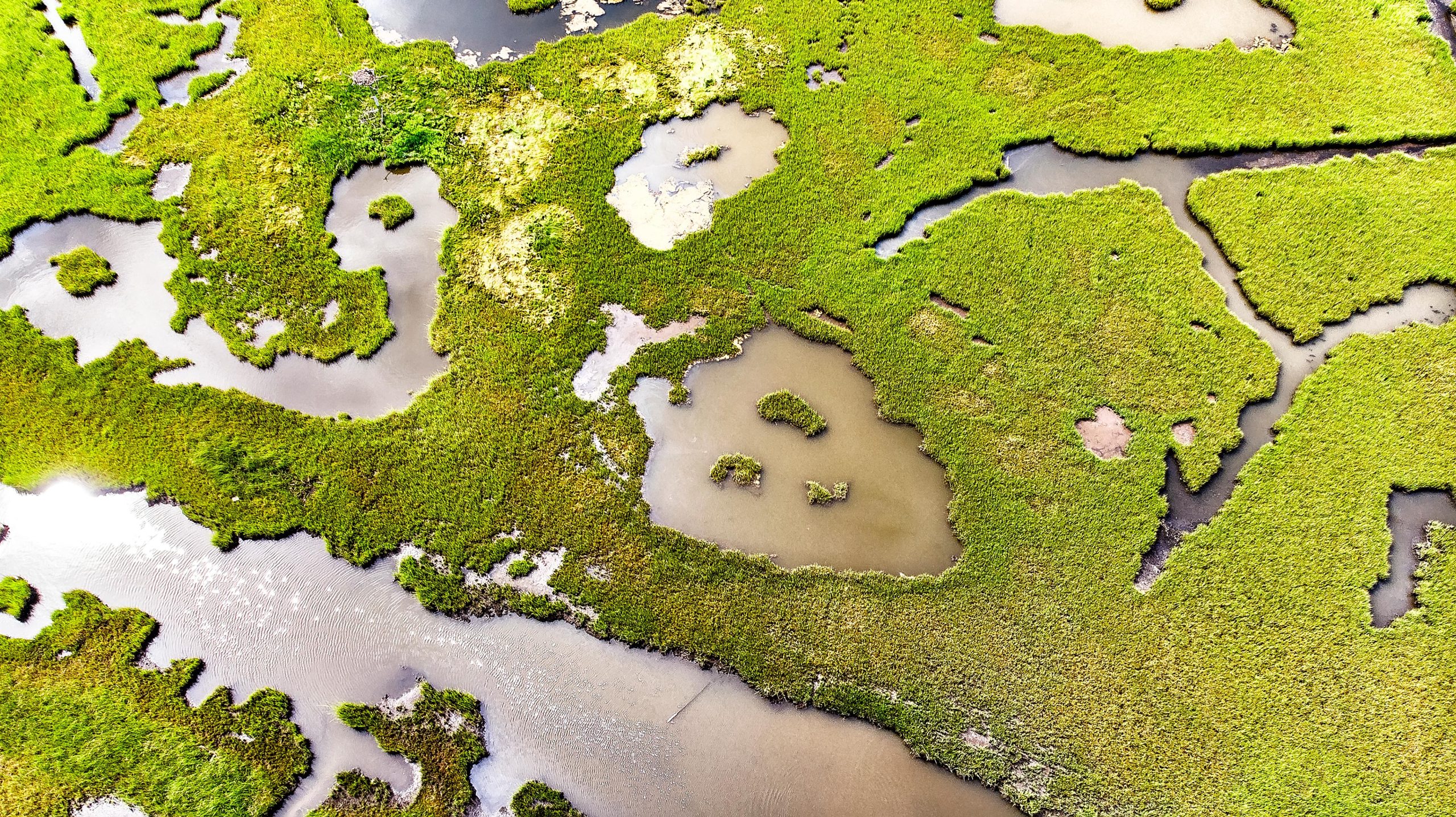
Salt marshes along the U.S. East Coast have been building elevation to keep pace with rising sea levels over the last century, according to a study published in Earth’s Future. While some marshes have adapted, there is a tipping point where they will no longer be able to keep up with rapid sea level rise. Slowing sea level rise is vital, but temporary measures like installing “living shorelines” or spraying mud slurries can help mitigate the impacts.
The world’s salty, tidal marshes are hotspots of carbon storage and productivity, building up sediments and plant material to stay above sea level. However, as sea level rises at an increasing rate, scientists debate whether it’s possible for wetlands to win the race. New research reveals how salt marshes along the U.S. East Coast have responded to accelerating sea level rise by building elevation more quickly to keep pace with the sea over the last century.
The study was published recently in the journal Earth’s Future, which publishes interdisciplinary research on the past, present, and future of our planet and its inhabitants.
Two main factors affect how quickly a salt marsh accumulates soil: how much sediment is deposited in the wetland during tidal floods, and how much organic matter from the marsh’s plants escapes decomposition. Humans can choke sediment supply to marshes by building dams or increase supply by causing erosion upstream, often through clearing land for agriculture. Cooler temperatures let more organic matter build up.
If sea level is rising slowly, sediment is plentiful, and vegetation is booming, a coastal wetland can keep pace with rising waters. But if sea level rises too quickly, that balance is lost.
Feedback Cycles and the Tipping Point
“These feedback cycles allow a marsh to keep up and increase its rate of soil accretion up until a point where it just can’t,” said Nathaniel Weston, an ecosystems ecologist at Villanova University who led the study. “After that, it falls off the other end and can no longer exist as a marsh. And it’s very likely that will happen in many places.”
The new study is the first to assess the race on a large scale, comparing soil accretion rates using soil core from nine salt marshes from Maine to Georgia. The dark, peaty columns record over 100 years of the marshes’ histories, and researchers dated the soil to calculate how quickly the wetlands grew over time and how that rate changed.
Although soil accretion sped up in all nine marshes, only six marshes built soil at roughly the same rate as sea level rise over the past century. Three marshes in North Carolina, South Carolina and Virginia could not keep up with local sea level rise due to rapid sea level rise, low sediment supplies from damming, and warmer temperatures.
“This is the first study to document what’s happening on this scale, across pretty much the entire East Coast,” said Weston. “We were definitely excited to see fairly consistent results across our sites, where the marshes were increasing their rate of soil accretion.”
Global Implications and the Road Ahead
Many coastal salt marshes around the world may be accelerating their growth, too, at least for the moment, Weston said.
Molly Keogh, a coastal geologist at the University of Oregon who was not involved in the study, echoed that sentiment. “There’s got to be a tipping point where wetlands simply can’t keep up with these increasingly fast rates of sea level rise,” she said. “There are places, like the Mississippi Delta, that have already reached these tipping points. At this point, the drowning of [coastal] wetlands is essentially inevitable.” Slowing sea level rise is key, but doing so is an incredibly difficult and slow task that won’t come quickly enough to save salt marshes, she said.
To slow the process of inundation, communities could install “living shorelines” of vegetation to retain sediment, Weston said. An expensive but temporary solution is to spray a slurry of mud and water over the marsh, which adds a few millimeters of sediment and can offset sea level rise a few years.
Reference: “Recent Acceleration of Wetland Accretion and Carbon Accumulation Along the U.S. East Coast” by Nathaniel B. Weston, Elise Rodriguez, Brian Donnelly, Elena Solohin, Kristen Jezycki, Sandra Demberger, Lori A. Sutter, James T. Morris, Scott C. Neubauer and Christopher B. Craft, 28 March 2023, Earth’s Future.
DOI: 10.1029/2022EF003037
Never miss a breakthrough: Join the SciTechDaily newsletter.
Follow us on Google and Google News.
1 Comment
Surprisingly, what is left out of this is that the coastal areas are often experiencing subsidence as a result of compaction over time, and the withdrawal of water from wells. This can be significant, and would lead to problems even if sea level were not rising.
However, to put things in perspective, the hand-wringing about the rate of sea level rise is about a geological phenomenon that is about 10% of the speed of tectonic plates. Nobody gets excited about tectonic plates unless there happens to be an earthquake resulting from them.